What Makes Ethnic Wear Look Luxurious
A product photo can make almost any embroidered lehenga look expensive. Real rooms are less forgiving. Under mixed lighting, after two hours of standing, and once the dupatta has been adjusted a dozen times, one outfit still looks composed. Another starts to look busy, stiff, or slightly unfinished.
That gap is what people mean when they say something “looks luxurious.” They are rarely talking about how much zari is on the surface. They are responding to weight, movement, proportion, and finish.
If you only remember one thing: luxury in ethnic wear is construction you notice in motion, not embellishment you notice in a flat lay.
Quick answer: which details actually read as luxury?
A lehenga, saree, Anarkali, sharara or salwar suit looks expensive when five things work together:
- The fabric falls with intention — it has drape and recovery, not a cardboard flare or a clingy collapse.
- The embroidery is seated in the cloth — smooth tension, secured ends, no puckering, no glue shine.
- The inside is finished like the outside — lining, seams, hems and edges are clean.
- The hidden hardware is considered — hooks, latkans, piping, buttons and drawstrings match the garment rather than fighting it.
- The fit is specific to the body — shoulders, bust, waist and length sit where the silhouette was designed to sit.
Heavy work on a poorly cut, poorly lined base still looks like costume. Quieter work on a well-built garment often looks like money.
Why two similar outfits can feel completely different
Ethnicwear shopping trains the eye to scan colour, motif density and price. Those are the easiest things to photograph. They are also the easiest things to copy.
What is harder to fake, and harder to judge from a single front image:
- How the skirt behaves when you walk
- Whether the blouse gapes when you raise an arm
- Whether sequins catch and pull when you sit
- Whether the hem kicks out cleanly or collapses into uneven waves
- Whether the reverse is a nest of knots and leftover thread
That is why a mid-weight georgette with disciplined finishing can outshine a stiffer, more heavily worked piece. The first one moves like clothing. The second one moves like a display.
Treat “more work” as a design choice, not a quality grade. Volume of embellishment tells you what the designer wanted you to notice. Construction tells you whether they could afford to be careful.
Start with drape, not with sparkle
Luxury begins in the hang.
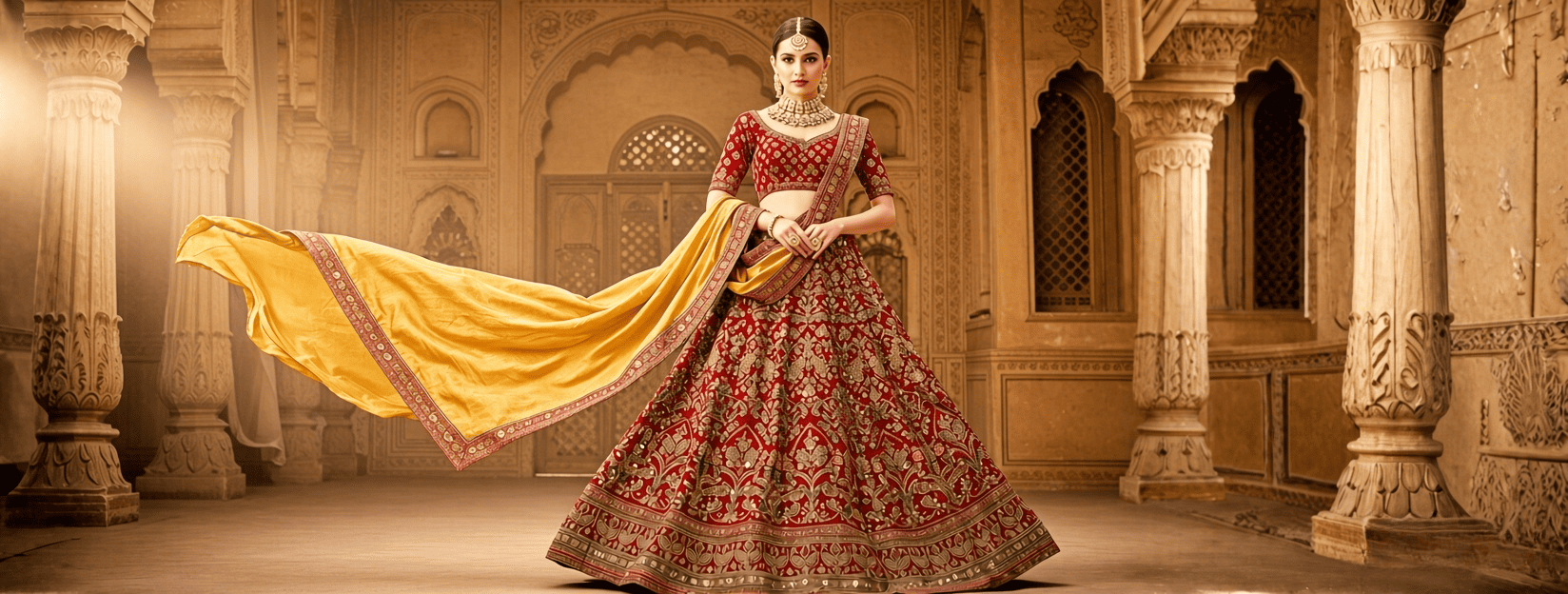
A well-made lehenga or Anarkali should change shape as you move and then return to a clean line. The flare should open, not jut. The skirt should have swing, not slap. A saree pallu should drop in a column instead of springing out like a board.
That behaviour comes from a mix of:
- Fibre and weave — silk, tissue, georgette, chiffon, crepe, organza, chinnon and velvet all carry embroidery differently
- GSM and body — too light, and heavy work drags; too stiff, and the garment stands away from you
- Lining weight — lining should support, not armour
- Hem finish and internal structure — can-can, canvas, kali panels and stay stitches decide whether a flare looks architectural or accidental
A useful in-person test: walk, turn, then sit. Look at the hem from the side, not only the front. If the silhouette only works when you are standing still facing a camera, the fall is not doing its job.
When you are buying from photos, ask for a movement video on a real body, not a cropped mannequin shot. Stills hide stiffness.
Fabric that looks rich is not always fabric that wears well
Occasion should drive the cloth.
Daytime functions often look more refined in fabrics with a softer hand and less bulk: lighter georgettes, crepes, fine silks, well-finished cotton-silk blends. Evening and wedding settings can carry tissue, richer silks, velvet and denser embroidery because the light and the formality support them.
The mistake is equating “festive” with “maximum weight.” An overloaded skirt that needs constant lifting does not look premium. It looks unmanageable. Comfort is not separate from luxury here. If you are fighting the garment, nobody is admiring the craftsmanship.
Embroidery quality is a construction problem
Surface prettiness is easy. Structural embroidery is not.
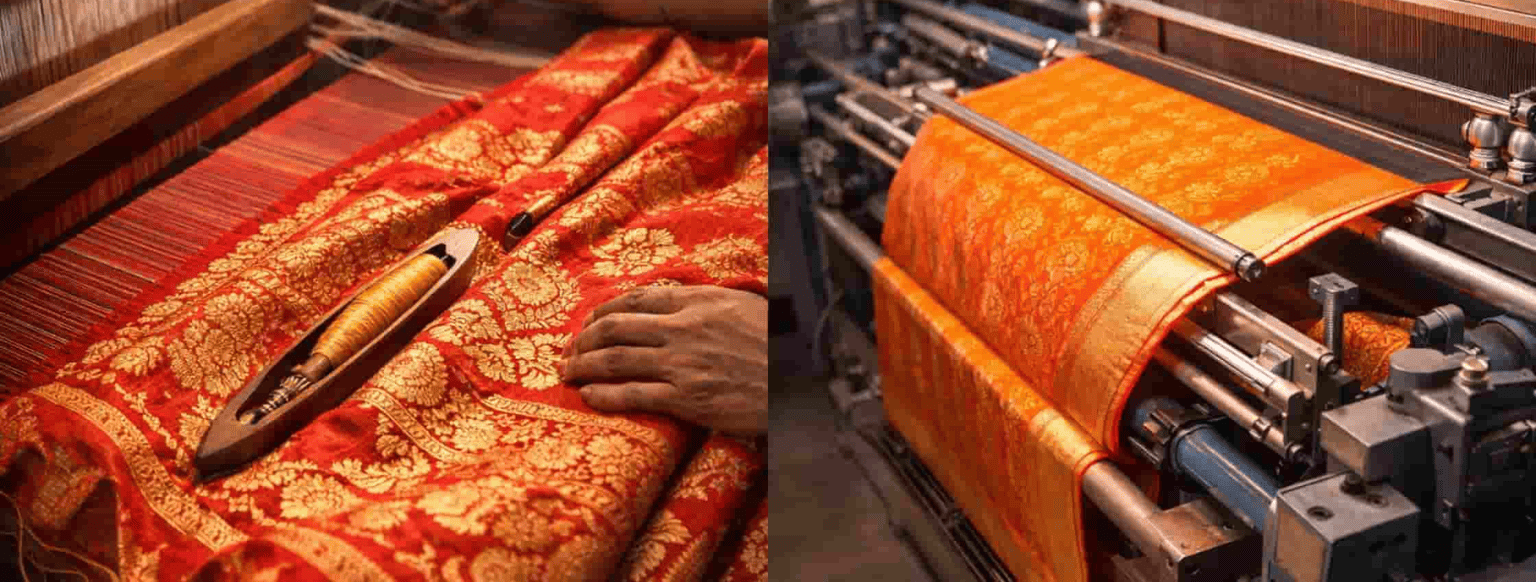
On a well-made piece, threadwork, zari, sequins, beads and stones sit in the fabric. The cloth around the motif stays flat. Motifs align across panels and borders. Ends are secured. The reverse, even if not decorative, looks controlled.
On a weaker piece you will see:
- Puckering around motifs
- Uneven density from one kali to the next
- Sequins or stones with a hard glue halo
- Embroidery that stops messily before a seam or hem
- Loose tails that will snag the dupatta in an hour
Hand-finished work often has slight variation in height and texture. That variation catches light in a way machine-perfect repetition does not. Machine embroidery can still be excellent — especially for clean geometric work — but glued-on density that looks identical from every angle in a photo often looks flat in person.
Check where the work ends. Borders, necklines, sleeve edges and pallu ends are where rushed production shows. If the motif frays into the seam allowance, the garment was decorated, not built.
Also check thread colour. Matched thread on seams, hems and linings is a small tell. High-contrast leftover thread on a pale organza is not.
The reverse side is the honesty test
If you can look inside, do.
Luxury finishing is repetitive and slightly obsessive:
- Seams graded or finished so they do not print through
- Raw edges overlocked, bound, or turned
- Pico, blind hem, or a clean facing rather than a wavy machine line
- Borders and lace joined so the join is hard to find
- Piping that follows a curve without wrinkling
A neat edge does more than “look tidy.” It frames the garment. The eye reads a sharp hem as intentional, the same way it reads a sharp neckline. Soft, chewed, or rolling edges make even good embroidery look less expensive.
This is one reason store visits still matter for wedding pieces. A photograph almost never shows the inside of a waistband.
Lining is the structure you are actually wearing
Lining is not a lining-item on an invoice. It is the garment’s skeleton.
Done well, it:
- Stops sheer cloth from clinging
- Gives heavy embroidery somewhere to sit
- Helps an Anarkali or kali lehenga hold shape without extra stiffness
- Reduces scratch from zari and sequins
- Makes the outfit cooler and more wearable over a long function
Done badly, it bunches, shows a mismatched colour through sheer zones, twists around the knees, or adds dead weight. You notice it the moment you sit.
Look for lining that is:
- Close in colour to the outer fabric, especially under pale or translucent cloth
- Cut to the same flare, not a narrower underskirt pretending to be enough
- Smooth at the hem, so it does not flash a separate, cheaper edge when you walk
- Light enough that the outer fabric can still move
If a listing never mentions lining, ask. For lehengas and structured Anarkalis, “unlined” is not automatically a deal-breaker, but you need to know what is supporting the work.
The small parts that finish the sentence
People remember the motif. They respond to the hardware.
These pieces rarely get their own product bullet, and they are often where a garment either feels considered or feels assembled:
- Fabric-covered buttons instead of generic plastic
- Latkans that match the palette and are sewn, not pinned as an afterthought
- Hook-and-eye placements that actually close the blouse
- Concealed zips that do not ripple
- Drawstrings that are finished, not cut and heat-sealed
- Piping and trims that continue around a neckline instead of stopping at a difficult curve
None of these will save a bad cut. Together, they keep a good cut from looking incomplete from the back, which is where a surprising number of ceremony photographs happen.
Fit is the fastest way to make good cloth look expensive
Extraordinary textile on a generic size still looks like a sample.
Ethnic silhouettes are unforgiving in specific places:
- Blouse or kameez shoulders — if they drop or bite, the whole neckline suffers
- Bust and princess seams — gaping reads as unfinished, not modest
- Waist — a lehenga that sits too low or too high throws the skirt proportions off
- Length — palazzo, sharara and lehenga hems need ground clearance that matches the shoe you will actually wear
- Sleeve and armhole — restricted movement makes even light fabric look heavy
- Dupatta mass — a beautiful drape in the wrong length becomes a management problem
Made-to-measure exists for this reason. If full custom is not possible, budget for a tailor who understands ethnic construction, not only Western alterations. Shortening a heavily worked hem is not the same as taking up trousers.
A practical rule: if you have to choose between a size that fits the bust and a size that fits the waist, fit the part that is hardest to alter on that particular garment, then plan the rest. On many blouses, shoulders and armholes are harder than side seams. On many lehengas, the waistband and hem embroidery limit what can be changed.
When an outfit fits, embroidery lands where it was drawn to land. That is why the same design can look couture on one body and busy on another.
Styling can undo a well-made garment
Construction gets you most of the way. Styling decides whether the room reads “refined” or “everything at once.”
The principle is hierarchy. One area should lead.
- Heavy lehenga, dense blouse, statement necklace, oversized earrings, embellished clutch and mirrored juttis will cancel each other.
- A quieter suit can take a stronger earring or a better metal.
- A loud dupatta may need quieter jewellery.
- A printed field usually wants simpler footwear than a solid, heavily worked skirt.
Colour works the same way. You do not need maximum contrast to look expensive. Tonal palettes — ivory on gold, rani on deeper rani, forest on bottle green — often photograph and sit in a room with more composure than five competing festive shades. Save high contrast for one element: a border, a blouse, or a jewel, not all three.
Dupatta styling is part of construction in practice. A pallu that is constantly slipping makes a good outfit look restless. Choose a drape you can maintain: one-shoulder, pleated over a blouse, or a secured ready drape if you do not want to negotiate with six metres of fabric all evening.
Footwear should finish the hem line. A beautiful skirt with the wrong shoe length looks unresolved. Match formality and colour family; you do not have to match embroidery stitch for stitch.
Hair and neckline are a pair. High embroidery collars and heavy chokers both occupy the same visual space. Pick one.
If you want a premium look on a simpler outfit, spend on fit, fabric hand, and one strong accessory — not on attaching more shine to a base that cannot carry it.
How to judge quality when you cannot touch the garment
Most festive shopping now happens on a screen. Photos are designed to sell surface. You have to interrogate them.
Ask for, or look for:
- Reverse or inside shots of a border, waistband and blouse
- Close-ups of motif edges, not only the prettiest centre panel
- A walk-and-turn video in natural light
- Lining colour and hem in the same frame as the outer fabric
- Fabric name and feel in plain language — “georgette with lining,” not only “premium fabric”
- Where the embroidery stops at seams, slits and necklines
- Blouse back and closure — luxury often dies at the hook tape
Questions worth sending a seller:
- Is the embroidery stitched, or are elements glued?
- What is the lining fabric, and is the skirt fully lined?
- Can the hem be altered without cutting through a worked border?
- How is the blouse finished at the armhole and neck?
- Does the listed size follow a standard chart, or is it garment-specific?
Be sceptical of a single studio image with heavy retouching and no scale. A motif can look delicate until you see it next to a hand.
In-store, do the unglamorous checks quickly: turn the hem, rub a motif lightly to see if anything shifts, hold the fabric up to light, sit down, lift your arms, and look at your back in a mirror. Those thirty seconds tell you more than the product title.
A practical quality checklist
Use this before you commit, especially for wedding and reception pieces.
Cloth and movement
- Does the fabric fall, or does it stand?
- Does heavy work drag the neckline or waistband out of shape?
- Does the skirt recover after you sit?
Workmanship
- Is the cloth flat around embroidery?
- Are motif edges and borders finished, or do they fray into the seam?
- Any glue shine, stray thread, or mismatched tension?
Inside
- Is the lining colour sensible under sheer areas?
- Are seams finished?
- Does the hem look as deliberate from the reverse as from the front?
Build
- Do closures lie flat?
- Are trims, latkans and piping part of the design, or extras?
- For pre-draped sarees and ready sets: do pleats stay after movement?
Fit
- Do shoulders, bust, waist and length work on your proportions?
- Can you eat, sit and raise your arms without the blouse or belt shifting?
If a piece fails the inside and movement tests, no amount of styling will make it look expensive for long.
What is worth paying for — and what is not
Pay for:
- Cloth with the right hand for the silhouette
- Lining and internal structure
- Secure, well-seated work
- A fit you will not fight
- Finishing at edges, necklines and closures
Be slower to pay for:
- Extra density that the fabric cannot support
- Trend colourways with careless insides
- “Heavy bridal” as a substitute for cut
- Accessories that repeat every idea already on the garment
A smaller, better-built wardrobe of suits, a sharara, a lehenga and a well-finished saree will give you more luxury evenings than a row of similar, overworked pieces in slightly different pinks.
Care is part of the same story. Heat, rough hanging and crushing will flatten zari, bruise tissue and twist linings. If you invested in construction, store it as construction: supported hangers for blouses, gentle folding for worked skirts, and cleaning methods that will not dissolve finishes.
The real test is not the first glance
The outfit that looks luxurious is the one that still looks intentional at the end of the function: hem still clean, blouse still sitting, embroidery still attached, drape still making sense.
Look closer than the colour story. Feel the weight. Check the reverse. Move. If those quiet parts are right, the room will register quality even if nobody can name why.
FAQs
What makes ethnic wear look luxurious?
Clean construction. Fabric that drapes, embroidery that sits without puckering, finished edges, a lining that supports the garment, and a fit that matches the silhouette. Surface embellishment only looks expensive when those things are already true.
How can I tell if a lehenga is good quality from photos?
You usually cannot from one front image. Ask for inside-waistband photos, border close-ups, lining shots and a video of the skirt moving. Look at motif edges and hems, not only the centre embroidery.
Does more embroidery mean a more premium outfit?
No. Extra work on unstable cloth, with visible glue or uneven tension, often looks cheaper than lighter, better-seated work on a fabric that moves.
Why does lining matter in a lehenga or Anarkali?
It controls cling, supports heavy work, helps the flare hold, and makes the garment wearable. A mismatched or bulky lining shows in sheer areas and at the hem when you walk.
How do I tell hand-finished work from machine or glued work?
Hand work usually has slight texture and irregularity; machine fills look very even; glued elements can show a stiff shine and lift at the edges. Texture is hard to judge without a close-up or the garment in hand.
Can styling make a simple ethnic outfit look expensive?
Yes, if the fabric and fit are already decent. Precise tailoring, a controlled colour story, one strong accessory, a stable dupatta drape and the right hem-to-shoe relationship do more than adding more jewellery.
Is made-to-measure worth it for festive wear?
For blouses, lehengas and anything with a defined waist or heavy border, fit is often the difference between “designed” and “almost.” If custom is not possible, get alterations from someone used to ethnic construction.
What should I check in a pre-draped saree?
Pleat security, pallu attachment, blouse finishing, and whether the drape holds after you sit and walk. Pre-drape only feels luxurious if the structure does the work you would otherwise do by hand.