Handloom vs Power Loom Sarees: What is the Difference in Saree Weaving
Buying a saree should feel joyful. But one label can turn it into a guessing game: handloom.
If you have ever stood in a store (or scrolled online) wondering whether a saree is truly hand woven or just made to look like it, you are not alone. The terms handloom and powerloom get used loosely, and the differences are not always obvious at first glance.
Let’s clear it up. This guide breaks down handloom vs powerloom sarees in plain language, shows you how to spot the signs, and helps you pick what makes sense for your budget and your occasion. I will also share a quick buying checklist you can use anywhere, including while browsing collections at Kesari Culture.
First, what “loom” actually means
A loom is simply the setup used to interlace threads.
- Warp threads run lengthwise (think of them as the base).
- Weft threads go across (they build the fabric row by row).
The big difference is not the final “look.” It is how those threads get interlaced.
What is a handloom saree?
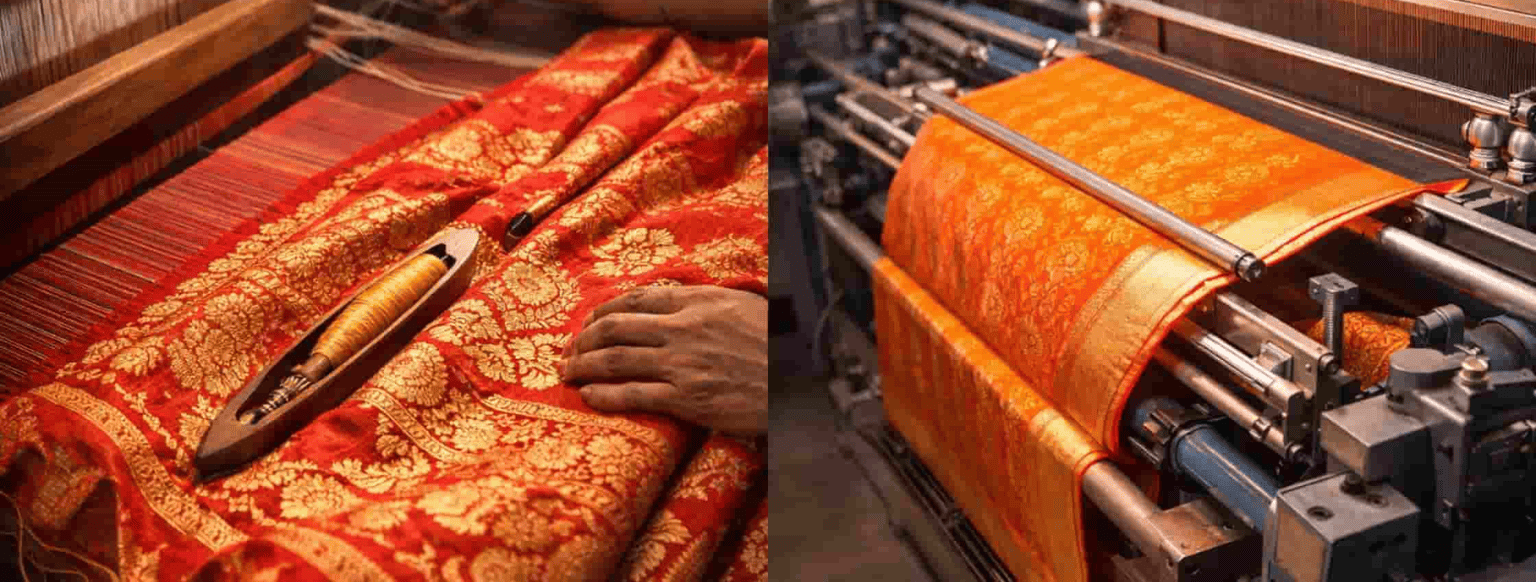
A handloom saree is woven on a loom operated by a person. It is not fully automated. The weaver controls the movement, tension, and pace, often with foot pedals and hand movements depending on the loom type.
That human involvement changes everything.
You may see tiny variations in spacing, a slight shift in motif alignment, or a gentle unevenness in the weave. That is not “bad quality.” In many traditional weaves, it is a sign the fabric was created by hand, not stamped out by a machine.
What makes handloom special (in real-life terms)
- Each piece has its own personality. Two sarees can follow the same design, but they rarely come out identical.
- The texture often feels more alive. Especially in cotton and silk, the hand woven structure can feel breathable and less “flat.”
- Craft matters. Many Indian weaves are deeply regional, like Banarasi, Chanderi, Jamdani, Maheshwari, Kanchipuram, Patola, and Pochampally.
If you are shopping curated heritage styles at Kesari Culture, this is usually the category people choose for weddings, festivals, and heirloom wardrobes.
What is a powerloom saree?
A powerloom saree is woven on an electrically operated loom. The process is mechanised, faster, and designed for consistent output.
Powerloom production is not automatically “cheap” or “low quality.” It simply means the fabric is made with machine assistance, which usually results in:
- Uniform patterns
- Consistent finish
- Faster production
- More accessible price points
Many people buy powerloom sarees for daily wear, office routines, travel, or for trends that might change next season. If you want a crisp, repeatable motif with minimal variation, powerloom can actually be the perfect fit.
You will also see plenty of powerloom options in modern saree edits, including at Kesari Culture, because they suit practical wardrobes.
Handloom vs powerloom sarees: the key differences that matter to buyers
Here’s a simple comparison you can screenshot.
| Feature | Handloom Sarees | Powerloom Sarees |
|---|---|---|
| Weaving method | Manually operated loom | Electrically operated machine loom |
| Look | Slight natural variations | Very consistent, repeatable patterns |
| Texture | Often richer, more breathable feel | Often smoother, more uniform finish |
| Production speed | Slower (depends on weave complexity) | Fast, suitable for bulk demand |
| Price | Usually higher due to labour and time | Usually more budget friendly |
| Best for | Weddings, rituals, gifting, collectors | Daily wear, workwear, quick styling |
How to identify a genuine handloom saree (without being a textile expert)
Some machine made sarees are intentionally designed to resemble handloom. So you need a few practical checks, not just a label.
1) Look closely for tiny irregularities
Hand weaving often leaves small “human” signs:
- Slight unevenness in the weave density
- Minor variations in motif edges
- A finish that feels less factory-perfect
Do not confuse this with defects like pulled threads, holes, or poor dyeing. Those are different.
2) Feel the fabric, slowly
Do this even when buying online (by checking the fabric description and close-up shots).
Handloom fabrics often feel:
- less stiff in a good way
- more breathable
- more textured (especially cotton and silk blends)
Powerloom fabrics often feel more uniform and sometimes a little more “slick,” depending on fibre and finish.
3) Check the reverse side (especially for borders and motifs)
Flip the saree if you can.
Handloom motifs and borders may show:
- slight differences on the back
- threads that indicate weaving construction rather than surface printing
Machine weaving can look very neat on both sides, with highly repetitive symmetry.
4) Watch out for “printed look” being sold as woven
A common confusion: prints vs weaves.
If a design looks like it is sitting on top of the fabric (ink-like) rather than built into the structure, it may be printed, not woven. Printing is not wrong, but it should not be sold as handloom weaving.
5) Ask about certifications where applicable
For silk sarees, sellers may mention certifications such as Silk Mark (for silk authenticity). Some craft focused platforms also refer to Craftmark for handcrafted verification.
Not every genuine handloom saree will carry a certification. Still, if a premium price is being charged, it is fair to ask for clarity.
If you are buying from a known store like Kesari Culture, ask for product details like weave technique, fibre, and place of origin. Transparent listings help buyers a lot.
Why handloom sarees usually cost more
People often ask this bluntly: “Why is handloom expensive?”
The short answer is time and skill.
A handloom saree can involve:
- manual set up of warp threads
- careful control of tension and alignment
- slow motif work depending on technique (like extra weft patterns)
- finishing steps handled by people, not automated lines
Also, pricing can reflect better yarn quality and smaller batch production.
That does not mean every pricey saree is handloom. Price is a clue, not proof. Use the identification tips above.
When powerloom is the smarter choice (yes, sometimes it is)
Handloom gets a lot of love, and rightly so. But powerloom has a real place.
Choose powerloom when:
- you want an affordable saree wardrobe for frequent use
- you need something lightweight for long office days
- you want a consistent pattern, especially for uniforms or coordinated gifting
- you prefer easy maintenance fabrics and finishes
If you like experimenting with colours and new drops, powerloom is often the low risk option. A lot of trend-forward styles you see in seasonal edits at Kesari Culture fit this lane.
Occasion-based cheat sheet: what should you buy?
No drama. Just practical picks.
Weddings and big functions
- If the goal is “once you wear it, people remember it,” handloom is usually the winner.
- Great for silk, rich borders, and heirloom value.
Festivals and family rituals
- Handloom cottons and silks look traditional without trying too hard.
- Powerloom can also work if the design reads festive and the fabric sits well.
Office and daily wear
- Powerloom shines here for cost, repeatability, and easy rotation.
- Handloom cotton can be brilliant too if you enjoy softer, breathable drapes.
Gifts
- Handloom feels meaningful because it signals craft and intention.
- If you are unsure of the recipient’s lifestyle, a subtle powerloom saree can be safer and easier to maintain.
Common mistakes people make while buying “handloom”
Mistake 1: Assuming “silk” means handloom
Silk is a fibre. Handloom is a method. A silk saree can be powerloom too.
Mistake 2: Falling for vague product descriptions
If a listing says “traditional,” “Banarasi style,” or “handloom pattern” but never states the weaving method, pause and ask.
Mistake 3: Ignoring returns and exchange policies
Even genuine products can arrive different from photos due to lighting and dye lots. Policies matter, especially online.
If you are shopping through Kesari Culture (or anywhere), check the fine print before you hit buy.
A quick buying checklist (works online and in-store)
Use this like a mini script.
- What is the weaving method? Handloom or powerloom (ask directly).
- What is the fibre? Cotton, silk, linen, blends.
- Is the motif woven or printed? Look for close-ups.
- Any proof points? Certifications where relevant, or clear sourcing details.
- How will I use it? Daily wear, occasion wear, gifting, travel.
- Care needs? Dry clean, gentle wash, fabric sensitivity.
Caring for your saree (so it lasts)
Handloom or powerloom, a little care goes a long way.
- Store sarees folded neatly in breathable fabric bags (especially silk).
- Avoid keeping silk in plastic for long periods. Moisture can cause trouble.
- Refold heavy sarees occasionally to avoid permanent crease lines.
- For zari or delicate silks, consider dry cleaning as a safer default.
- Keep perfumes and deodorants away from direct contact with silk.
If you are building a collection from Kesari Culture, it is worth keeping a simple note on each saree’s fabric and wash needs. Future you will be grateful.
The takeaway
The real difference between handloom vs powerloom sarees is the weaving process. Handloom brings individual character, heritage craft, and often a richer feel. Powerloom offers consistency, speed, and affordability.
Neither is “always better.” The best choice is the one that fits your life.
If you want to shop smarter, use the identification checks, ask better questions, and buy from sellers who give clear product details. That includes when you are exploring sarees at Kesari Culture, where transparency in weave and fabric descriptions makes decision-making much easier.
Suggested FAQ
1) What is the main difference between handloom and powerloom sarees?
Handloom sarees are woven on manually operated looms by artisans. Powerloom sarees are woven on electrically operated machines, which makes production faster and patterns more uniform.
2) How can I identify a genuine handloom saree at home?
Look for slight natural irregularities, feel for a more textured and breathable weave, and check the reverse side of motifs and borders for signs of manual weaving.
3) Are handloom sarees always better quality than powerloom sarees?
Not always. Handloom often offers craftsmanship and unique character, but powerloom can still be well-made and durable. “Better” depends on your use case and fabric quality.
4) Why are handloom sarees more expensive?
They usually take longer to weave and require skilled manual labour. Pricing may also reflect smaller production and higher quality yarns.
5) Can powerloom sarees look like handloom?
Yes. Many machine made sarees mimic traditional motifs and layouts. The difference usually shows up in texture, uniformity, and the overall “hand” of the fabric.
6) Is every silk saree a handloom saree?
No. Silk refers to the fibre. A silk saree can be handloom or powerloom depending on how it is woven.
7) What certifications should I look for when buying silk sarees?
For silk authenticity, sellers may mention Silk Mark. Some handcrafted verifications may reference Craftmark. Availability varies, so treat certifications as helpful signals, not the only proof.
8) Which is better for daily wear, handloom or powerloom?
Powerloom is often chosen for daily wear because it is affordable and consistent. Handloom cotton sarees can also be excellent for daily wear if you prefer breathable fabric with a softer drape.