Top 10 Most Popular Types of Silk Sarees from Across India
Silk saree names get used as if they were colours. People say they want a Banarasi, then buy a shiny fabric with some gold print. Or they ask for Kanjeevaram when they actually need something they can wear through a long, hot function.
The useful distinction is not “which one is the most expensive.” It is what the cloth is doing: how heavy it is, how it falls, whether the pattern is woven or printed, and whether it belongs at a wedding, a temple, or a weekday celebration.
This is a working map of the types of silk sarees you will actually encounter — the famous regional weaves, the fabric names shops use more loosely, and how to choose without getting lost in catalogue language.
What actually makes one silk saree different from another
Geography is a starting point, not the whole story. A name like Banarasi or Paithani points to a weaving tradition. A name like organza or dupion points to how the yarn was reeled and woven. Shops mix both on the same rack.
Look at four things:
Fibre. Mulberry silk is smooth and often brighter. Tussar, muga, and eri come from other silkworms and look more matte, slubby, or naturally golden. Blends (silk-cotton, silk-organza) change the fall completely.
Weight and body. A Kanchipuram can feel like it has architecture. A Chanderi can feel almost like air. That difference decides comfort, drape, and whether you need a firm petticoat.
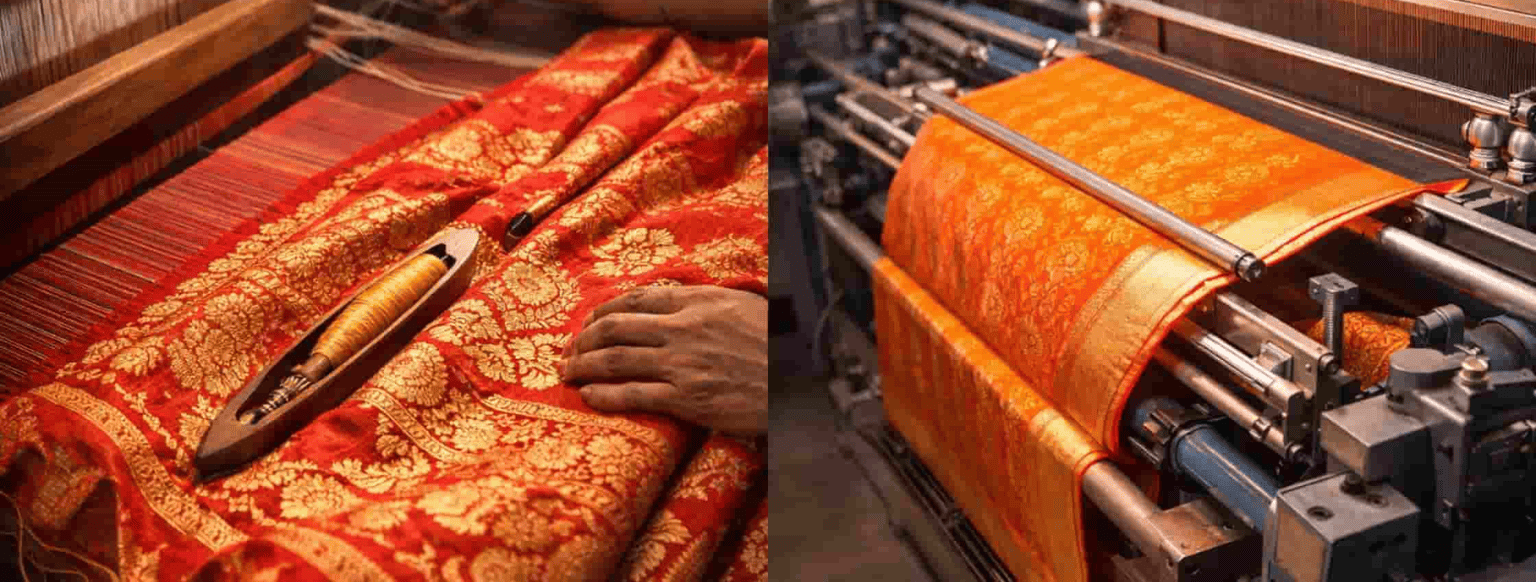
How the pattern is made. Brocade, ikat, tapestry-style pallus, extra-weft motifs, and embroidery are not interchangeable. A printed “Banarasi” is a different object from a woven one, even if the motifs look similar in a photo.
Border and pallu. Some traditions put the drama in a contrast border. Others put a story on the pallu. Others keep a plain body and a thin gold edge.
If you can describe those four, you can shop. The regional name then becomes useful instead of decorative.
The regional weaves people usually mean
These are the names most shoppers are trying to learn. Treat them as families of cloth, not as one identical product.
Banarasi (Varanasi, Uttar Pradesh)
What you notice first is often the brocade: floral jaals, vines, butis, sometimes a dense gold or silver ground. The historical influence is courtly and Mughal as much as temple. The silk can be heavy, but Banarasi today also includes lighter organza, georgette, and katan versions.
Wear it when the occasion can take some formality — weddings, receptions, big festive evenings. A lighter Banarasi can work for a guest look without the full bridal weight.
Watch for: all-over glitter that is foil or print rather than extra-weft zari. Also watch for the word Banarasi used on any fabric that happens to have paisleys. Ask whether the pattern is woven. Check the reverse; woven work has a logic on the back, even if it is not identical to the front.
A quiet blouse usually helps. The saree is already doing a lot.
Kanjeevaram / Kanchipuram (Tamil Nadu)
This is the South Indian silk many families still buy as an heirloom. The classic version is tightly woven mulberry silk with a substantial hand, often a contrast border, and motifs that lean toward temples, checks, peacocks, and geometric borders. The pallu is frequently a statement of its own.
Not every Kanchipuram has a screaming contrast border. Some are single-colour with a restrained zari edge. The shared quality is density and a kind of stiffness that becomes a drape once it is worn and aired.
Wear it when the event is ceremonial: weddings, important pujas, formal family functions. It photographs as “finished” even with a simple blouse.
Watch for: weight that is only starch, and borders that are stitched on rather than woven in the tradition you are paying for. A good piece should feel woven as one textile, not like a body with a ribbon attached. Jewellery can be traditional gold; a high-neck or boat-neck blouse keeps the upper half as architectural as the cloth.
Paithani (Maharashtra)
Paithani is usually recognised by its colour sense and by the pallu: lotuses, peacocks, and related motifs built in a tapestry-like way, with a border that often has a distinctive rhythm. It can be vivid without looking like costume, which is why it is a wedding staple in Maharashtrian families and well beyond them.
Wear it when you want bridal or festive formality with a different vocabulary from Banarasi or Kanchipuram.
Watch for: printed peacocks sold as Paithani. The real interest is in the woven pallu and the way the colours lock. A simple blouse lets the pallu do the talking when you drape it.
Chanderi (Madhya Pradesh)
Chanderi is light. Many pieces mix silk with cotton, which is why they suit warm weather and long days. The cloth can look faintly sheer. Motifs tend to be smaller — coins, florals, fine extra-weft details — rather than a heavy gold forest.
Wear it when you need traditional clothes you can actually sit, walk, and eat in: summer weddings as a guest, daytime functions, festive office days.
Watch for: confusing Chanderi with generic sheer tissue. The drape should still have some dry, crisp character, not just cling. A sleeveless or short-sleeve blouse in a solid colour grounds the transparency.
Mysore silk (Karnataka)
Mysore silk is often the opposite of a busy Banarasi. Think a smooth, relatively lightweight silk, a clean body, and a gold border that does not need to shout. The appeal is even colour and a polite sheen rather than dense figuration.
Wear it when you want formal without bridal: temple, family gathering, office celebration, a function where heavy zari would feel overdressed.
Watch for: very similar-looking plain silks from elsewhere sold under the name. The buying question is quality of silk and evenness of the border, not a motif checklist.
Tussar (several regions, including Jharkhand, Bihar, Chhattisgarh, Odisha, West Bengal)
Tussar is a different silk personality. It is often slightly coarse or slubby, with a natural beige-gold that dyes into earthy and muted shades especially well. It looks hand-made even when the design is simple. That is the point for a lot of people.
Wear it when you want traditional clothes that do not read as wedding-only: cultural events, daytime festive, travel, some workplaces.
Watch for: stiffness from heavy chemical finish. Good tussar has life in the yarn, not a plastic shine. Oxidised silver and a plain cotton or raw-silk blouse sit more naturally than a full temple set, unless you are deliberately mixing.
Bhagalpur in Bihar is closely associated with tussar weaving and finishing, which is why “Bhagalpuri silk” appears as its own shop label. Some Bhagalpuri sarees are printed or painted on tussar; others are plainer weaves. Judge the cloth, not only the city name.
Patola (Patan, Gujarat)
Genuine Patola is double ikat: warp and weft are both resist-dyed before weaving, which is why the geometry looks locked in from both sides and why a real piece is slow to make and costly. The patterns are bold, often geometric, and very specific in drawing.
Wear it when the occasion matches the investment — weddings, serious festive wear, a textile you intend to keep.
Watch for: the word Patola on printed or single-ikat lookalikes. Those can still be beautiful. They are not the same object. If the price seems too friendly for a handwoven double ikat, it probably is. Ask what technique was used, and look at the reverse and the edge of the motif.
Baluchari (West Bengal)
Baluchari puts narrative on the pallu: figures, courtly or mythological scenes, borders that read like a framed panel. You buy it as much for the picture as for the silk.
Wear it when a cultural or festive setting can appreciate the pallu — and when you will drape that pallu so it can be seen, not crushed under a bag.
Watch for: pictorial prints that mimic the scenes. Woven figuration has a different depth. A plain blouse is almost required; a busy blouse next to a story pallu is visual noise.
Muga and other Assam silks
Muga is the Assamese silk most people mean when they talk about a natural golden glow that does not depend on zari. It is prized, durable when cared for, and culturally specific. Eri is softer and more matte; pat (mulberry) is another local strand of the tradition.
Wear muga when the event is traditional and you want richness without a thick brocade crust. It is not a casual office silk in the way some tussar is.
Watch for: golden-dyed substitutes. Muga’s colour has a particular warmth. Provenance and a trusted seller matter more here than a motif name.
Gadwal (Telangana)
Gadwal is loved for a practical combination: a lighter, often cotton or cotton-silk body with a silk border and a more ceremonial pallu. You get contrast and zari where it shows, and wearability through the long middle of the day.
Wear it when you want festive structure without Kanchipuram weight — temples, festivals, traditional gatherings in heat.
Kota (Rajasthan)
Kota Doria is a square, airy graph-check weave, often cotton with silk, built for hot weather. It is sometimes sold in silk-forward versions. The feel should be springy and light, not limp.
Wear it when summer, daytime, and movement matter more than heirloom density.
Fabric names that are not the same as a weaving town
These labels describe the yarn or the hand of the cloth. They can be beautiful. They are not a substitute for Banarasi or Paithani.
Organza. Crisp, sheer, light. Good for evening and contemporary drapes. Needs a careful blouse and often a well-chosen underskirt because it reveals structure.
Dupion. Slubs, a dry crispness, a more “designed” fall. Reads modern-formal. Can feel less fluid than a fine mulberry.
Raw silk / noil-adjacent textures. More matte, more tooth. Useful when you want silk without bridal shine.
“Pure silk” as a tag. It should mean the fibre, not automatically a famous weave. Ask which silk, which weave, and whether there is mixed yarn.
If a listing says “Banarasi organza,” both words are doing work: the motif tradition and the base cloth. Price and care follow the combination, not the prettier noun.
How to choose by occasion, not by prestige
Wedding (bride or very close family). Kanchipuram, heavy Banarasi, Paithani, serious Patola, or muga — depending on the family’s textile language. Weight is a feature if you want the cloth to feel ceremonial. It is a problem if you cannot walk.
Wedding guest. A lighter Banarasi, Mysore, Gadwal, a well-finished tussar, or Chanderi. You should be able to sit on a chair for three hours.
Temple and ritual. Mysore, Gadwal, Kanchipuram in a simpler colourway, cotton-silk with a real border. Avoid trailing pallus that pick up floors.
Daytime festive / summer. Chanderi, Kota, tussar, lighter Gadwal.
Evening party where traditional is optional. Organza, dupion, a sleek plain silk, a contemporary Banarasi on a lighter base.
Work or daytime traditional. Tussar, Chanderi, a plain Mysore-like silk. Heavy zari under office lights can look overdressed and feels worse.
Colour is secondary to weight. A bright lightweight silk is easier than a pastel brick.
Blouse and jewellery, kept simple
Match metal and mood to the cloth, not to a celebrity board.
- Heavy zari weaves: quieter blouse, gold if that is your jewellery language.
- Tussar and many handlooms: duller metals, less bridal sparkle.
- Sheer Chanderi or organza: a lined, well-cut blouse; the neckline does more than embroidery.
- Pictorial pallus (Baluchari, some Paithani): plain blouse so the pallu remains the image.
If the saree already has a thick gold border, a heavily embroidered blouse is usually one idea too many.
Care that actually protects the cloth
Silk fails from storage more often than from one wearing.
- Prefer dry cleaning for heavy zari and structured silks unless you know the piece is safe for careful home wash.
- Wrap in muslin or a cotton saree cover, not plastic.
- Keep it away from direct sun in storage.
- Refold on a different line a few times a year so one crease does not become a cut.
- Do not spray perfume onto the fabric.
- Let a worn saree air before it goes back in the cupboard.
- Starch and harsh ironing can make a silk look formal once and tired forever. Use a cloth between iron and zari.
A well-made silk is one of the few clothes that can be worn across decades if it is not sealed in damp or crushed in the same fold.
How to buy without getting confused
Ignore the word “bridal” on a tag. Ask:
- Which fibre? Mulberry, tussar, muga, blend?
- Is the pattern woven, printed, or embroidered?
- How heavy is it in the hand, not only in the photograph?
- Is the border woven with the body?
- What will I wear it to, in this climate?
Handwoven pieces vary slightly. That irregularity can be a sign of the real thing, not a defect. Machine evenness has its place; it should not be sold as a GI weave it is not.
Certificates help when the price is high, but they are not a substitute for looking at the reverse, the selvedge, and the fall. If you are spending heirloom money, buy from someone who will still be answerable after the wedding.
The types of silk sarees in India are less a ranking than a set of tools. Banarasi and Kanchipuram carry ceremonial weight. Paithani and Patola are specific visual languages. Chanderi, Kota, and tussar solve heat and hours. Muga and Baluchari are easier to love if you care about what the cloth is saying, not only how much it shines.
If you are choosing one next, name the day first — heat, hours, how formal the room is — and only then pick a weave. The right silk is the one you can drape, sit in, and put away without regret, not the one with the most famous name on the bill.
Frequently Asked Questions
What is the difference between Banarasi and Kanjeevaram silk?
Banarasi is typically associated with brocade florals and jaals from Varanasi. Kanjeevaram (Kanchipuram) is a denser Tamil silk tradition, often with a strong border and pallu and a heavier, more structured hand. Both have lighter modern versions; the classic pieces still feel different in weight and motif language.
Which silk saree is best for weddings?
For a bride, families often choose Kanchipuram, heavy Banarasi, Paithani, or another locally meaningful heirloom weave. Guests are usually more comfortable in a lighter Banarasi, Mysore, Gadwal, or Chanderi.
Is Tussar a good everyday silk?
It can be, especially compared with heavy bridal weaves. It is breathable, less glittery, and more informal in mood. “Everyday” still depends on how dressy your workplace or family setting is.
What is special about Patola?
True Patola from Patan uses double ikat, which is slow and expensive. Many sarees sold as Patola are printed or otherwise imitated. Ask about technique and treat the price as a clue.
Are Chanderi sarees pure silk?
Often they are silk-cotton or otherwise blended, which is why they are light and slightly sheer. That mix is part of their usefulness, not automatically a downgrade.
How can I tell if zari work is woven?
Look at the reverse and the way the motif sits in the cloth. Woven extra-weft or brocade has structure in the fabric. Print and foil sit more on the surface and often look too perfect, or too flat, up close.
Which silk is most comfortable in summer?
Chanderi, Kota, lighter tussar, and Gadwal-style bodies are generally easier than a heavy Kanchipuram or dense brocade Banarasi.
Do silk sarees need dry cleaning every time?
Heavy zari and structured pieces are safer with professional cleaning. Some simpler silks can be handled more gently at home if you know the dye and finish. When unsure, dry clean and store in cotton.
Is Mysore silk only for formal events?
It sits well at formal but not necessarily bridal events — temple, family functions, office festive days — because it is often lighter and less ornate than Kanchipuram or Banarasi.
What should I buy if I can only own one silk saree?
Choose by your actual calendar. If you attend weddings, a medium-weight Banarasi or a simpler Kanchipuram in a reusable colour will work harder than a fragile party organza. If you rarely need bridal clothes, a good tussar or Chanderi will leave the cupboard more often.